

AI for Finance
Lead AI with strategic vision and financial insight
AI for Finance: Drive transformation in finance with AI
Guided by accomplished Rotman faculty and instructors, you will gain insights into AI, finance and governance while engaging with tools and case discussions that challenge your thinking and sharpen executive judgment. Through real-world financial use cases, you will examine how AI can improve processes and performance across financial planning and analysis (FP&A), accounting, audit, fraud detection and regulatory compliance, driving greater efficiency across the finance function. By the end of the program, you will be equipped to lead AI adoption in finance effectively and responsibly, assess where it can create the greatest value and scale its adoption with the strategy, governance and organizational capabilities needed for sustained impact.
86%
82%
What will you learn in the AI for Finance program?
Key takeaways
The AI for Finance program will enable you to:
Acquire a practical, executive-level understanding of AI and its implications for finance
Identify where AI is currently creating value in finance, FP&A, accounting, audit, risk and compliance
Assess the strategic, regulatory and ethical implications of adopting AI in finance
Oversee the validation, governance and performance standards required for trustworthy AI in financial workflows
Communicate confidently with technical and cross-functional teams to shape AI-driven initiatives
How is the AI for Finance program curriculum structured?
Module 1: AI Essentials for Finance
Build the vocabulary and mental models to evaluate AI in finance. Distinguish predictive, generative, and agentic AI from robotic process automation (RPA), and apply frameworks such as the Iceberg Model and Four Pillars to assess AI opportunities and data readiness. In this module, you will:
Identify the characteristics and applications of different AI technologies in finance
Assess the feasibility of AI opportunities based on business needs, data availability and organizational readiness
Apply the Iceberg Model and Four Pillars frameworks to evaluate potential AI initiatives
Determine which finance problems are suited to AI and which require alternative approaches
Module 2: AI for Financial Planning and Analysis (FP&A)
Explore how AI can advance forecasting, variance analysis and scenario planning for strategic FP&A. Compare traditional and AI-native approaches using machine learning, synthetic data and LLM-based financial data access, with responsible implementation in mind. In this module, you will:
Evaluate how AI can improve the accuracy, speed and depth of financial analysis
Compare traditional and AI-native approaches to forecasting and scenario planning
Assess how different AI methods can address specific FP&A challenges
Identify the capabilities, data and controls needed to operationalize AI in FP&A
Translate AI-generated insights into more effective strategic recommendations
Module 3: AI in Accounting, Audit and Financial Operations
Examine how AI can move accounting and financial operations beyond transactional work. Examine applications across financial close, document processing, reconciliations, liquidity management and continuous auditing, with responsible controls and human oversight. In this module, you will:
Identify high-value opportunities for AI across accounting, audit and financial operations
Evaluate how AI can improve core processes while balancing automation with human judgment
Design appropriate controls and oversight for responsible AI deployment in finance
Module 4: AI in Risk, Compliance and Fraud Detection
Assess how AI can strengthen fraud detection, risk management and compliance while introducing new risks. Examine bias, opacity and the trade-off between performance and explainability in high-stakes financial decisions. In this module, you will:
Evaluate AI applications for fraud detection, risk management and compliance
Identify sources of bias and opacity in AI-driven financial decisions
Assess the trade-offs between model performance, explainability and regulatory requirements
Determine appropriate safeguards for using AI in high-stakes financial contexts
Module 5: AI Experimentation, Validation and Performance Optimization
Assess AI deployment readiness in finance. Examine validation across predictive, generative and agentic systems, including model risk, drift, explainability and human oversight. In this module, you will:
Make informed deployment decisions by assessing AI performance, reliability and readiness across different AI systems
Identify performance risks by understanding data and concept drift and knowing when models need intervention
Set the right level of oversight by matching explainability, governance and human involvement to the risks of each AI application
Module 6: AI Strategy for Finance Leaders
Move from individual AI applications to a finance-wide strategy. Assess where AI can create advantage, build a defensible investment proposal and consider its impact on roles, capabilities and ways of working. In this module, you will:
Build the business case for AI by weighing its strategic value, investment and organizational readiness
Develop a road map for adoption that connects priority opportunities with the capabilities needed to scale them
How does the AI for Finance program use applied learning?
AI for finance playbook
Build the AI fluency to identify where it can create value, evaluate where it fits, and shape how it is applied across finance.
Throughout the program, you will develop an AI in Finance Playbook that connects each module’s learning to the priorities and realities of your own organization. You will assess AI readiness, identify and prioritize high-value finance use cases, evaluate risks and governance requirements, and determine what responsible implementation should look like. By the end of the program, you will have a tailored road map for applying AI across the finance function with greater clarity, control, and strategic direction.
Frameworks and conceptual models

AI Taxonomy

Iceberg Model

Four Pillars

FP&A Learning Loop

Three-Sided Reality of AI in Risk

AI Assembly Line

Data Drift vs. Concept Drift Decision Framework

Model Risk Tiering + Explainability Trade-off
What are the highlights of the AI for Finance program?

AI implementation playbook
Translate key insights into action by developing a cumulative AI implementation playbook that can be applied to your organization.

Live sessions
Attend interactive sessions with Rotman faculty and instructors to explore real-world cases, refine frameworks and apply insights to finance contexts.

Real-world case studies
Examine real-world AI applications in finance to assess their impact, limitations and critical success factors.

Framework-based analysis
Apply structured frameworks and models to reinforce rigorous, repeatable evaluation and implementation-thinking.

Expert Rotman instructors
Gain insights from distinguished Rotman faculty and instructors specializing in finance strategy and responsible AI integration.

Learn with the AI Tutor
Get instant replies to your questions about program content from our AI Tutor. Find the information you need to learn more confidently and move through topics and key learnings.
Note: The topics are indicative and subject to change based on speaker availability.
Who should enrol in the AI for Finance program?
Chief financial officers and senior finance executives | Shape enterprise AI strategy, make investment decisions and remain accountable for the implications of AI adoption across the finance function. |
Vice presidents and directors of FP&A | Transition from reporting and budgeting toward driver-based forecasting, scenario analysis and strategic decision-making using AI. |
Controllers and senior leaders in accounting and financial operations | Oversee the close, reconciliations and controls environment while evaluating where automation and AI-assisted judgment can fit with governance. |
Senior leaders in risk, audit and compliance functions | Navigate model risk, fairness, explainability and regulatory expectations as AI enters financial decision-making. |
Transformation leaders and consultants | Build the road map that connects AI opportunities to data readiness, governance and measurable business outcomes. |
General management and business leaders, including CEOs, managing directors and business heads | Understand how AI affects finance, from productivity and decision rights to enterprise value creation. |
Technology, data and analytics leaders | Partner with finance to prioritize AI use cases, align technology and data capabilities and enable responsible implementation. |
Who teaches the AI for Finance program?
Instructors

Zissis Poulos
Assistant Professor of Financial Technologies at the School of Information Technology at York University
Prior to joining York University, Zissis Poulos was a postdoctoral fellow at the Rotman School of Management at the University of Toronto. His research focuses primarily on ma...

Scott Liao
Distinguished Professor in Financial Analytics and Banking; Professor of Accounting, the Rotman School of Management
Scott Liao is the vice dean of pre-experience and specialized programs at the University of Toronto, distinguished professor in financial analytics and banking and professor o...
What credentials will you gain from the AI for Finance program?
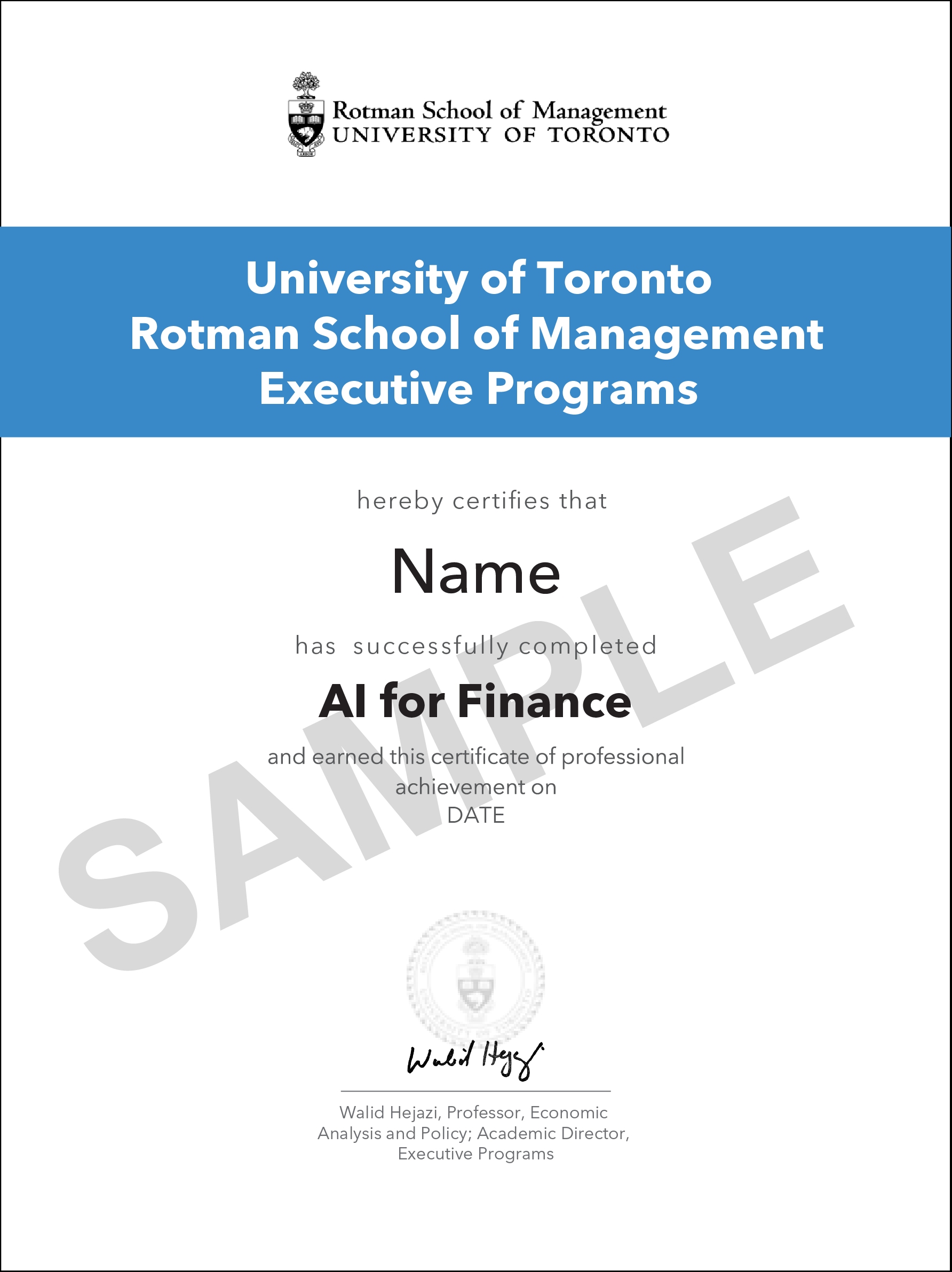
Certificate
Upon successful completion of this 6-week virtual learning program, you will earn a verified digital certificate of completion from the Rotman School of Management. This program also counts toward the Rotman Excellence in Executive Leadership Certificate.
FAQs
What can an AI for Finance program offer finance professionals today?
AI is rapidly transforming how finance teams analyze data, forecast performance, manage risk and support strategic decision-making. For finance professionals, the value of an AI program is not in learning to build AI models from scratch but in understanding where AI can create value and developing the judgment to make informed decisions about its use.
The AI for Finance program from the Rotman School of Management is designed to help finance professionals evaluate AI opportunities, assess risks and translate AI-generated insights into stronger financial and strategic decisions.
What should you look for in an AI for finance course as a finance professional?
An effective AI for finance course should go beyond tools and technology to address the decisions finance leaders face across planning, analysis, accounting, risk and operations. It should combine finance-specific applications with practical frameworks for assessing feasibility, performance, governance and business value.
The AI for Finance program from the Rotman School of Management brings these elements together through practical frameworks, real-world case studies and applied exercises, enabling you to evaluate AI opportunities and make informed decisions about adoption and scale.
How is an AI for finance course different from a general AI program?
A general AI program typically explores AI concepts and applications across industries, while an AI for Finance program focuses on how these technologies can transform financial decision-making and core finance functions.
The AI for Finance program from the Rotman School of Management examines AI applications across FP&A, accounting, audit, financial operations, risk, compliance and fraud detection while enabling you to develop the judgment needed to balance AI-driven insights with human expertise, governance and regulatory requirements.
Are there AI for finance programs that focus on real-world applications?
Some AI courses focus primarily on building technical knowledge, while others take a broader strategic approach. For finance professionals, the most valuable programs connect AI capabilities to real financial challenges and decisions, with opportunities to apply concepts in practical contexts.
The AI for Finance program from the Rotman School of Management takes an applied approach through finance-specific case studies, practical frameworks and hands-on exercises. You will assess AI use cases, evaluate performance and risks and explore how AI can be responsibly integrated into financial workflows.
Is AI training necessary for finance leaders to lead AI initiatives?
Leading AI initiatives in finance requires more than an understanding of the technology. Finance leaders need to evaluate business cases, assess data and model risks, establish appropriate controls and determine where human judgment should remain central to decision-making.
The AI for Finance program from the Rotman School of Management develops these capabilities across the AI life cycle, from identifying and validating opportunities to designing governance, assessing performance and building a road map for responsible adoption and scale.
The program
How do I know if this program is right for me?
After reviewing the information on this program page, we recommend you submit the short form above to gain access to the program brochure, which includes more in-depth information. If you still have questions on whether this program is a good fit for you, please email learner.success@emeritus.org, and a dedicated program advisor will follow up with you very shortly.
Are there any prerequisites for this program?
Some programs do have prerequisites, particularly the more technical ones. This information will be noted on this program page, as well as in the program brochure. If you are uncertain about program prerequisites and your capabilities, please email us at learner.success@emeritus.org.
Note that, unless otherwise stated on the program web page, all programs are taught in English and proficiency in English is required.
What is the typical class profile?
More than 50 percent of our participants are from outside Canada. Class profiles vary from one cohort to the next, but, generally, our online certificates draw a highly diverse audience in terms of professional experience, industry, and geography — leading to a very rich peer learning and networking experience.
What other dates will this program be offered in the future?
Kindly refer to this program page or email us to inquire if future program dates or the timeline for future offerings have been confirmed yet.
The learning experience
How much time is required each week?
Each program includes an estimated learner effort per week. This is referenced at the top this program page under the Duration section, as well as in the program brochure, which you can obtain by submitting the short form at the top of this page.
How will my time be spent?
We have designed this program to fit into your current working life as efficiently as possible. Time will be spent among a variety of activities including:
Engaging with recorded video lectures from faculty
Attending webinars and office hours, as per the specific program schedule
Reading or engaging with examples of core topics
Completing knowledge checks/quizzes and required activities
Engaging in moderated discussion groups with your peers
Completing your final project, if required
The program is designed to be highly interactive while also allowing time for self-reflection and to demonstrate an understanding of the core topics through various active learning exercises. Please email us if you need further clarification on program activities.
What is it like to learn online with the learning collaborator, Emeritus?
More than 350,000 learners across 80 countries have chosen to advance their skills with Emeritus and its educational learning partners. In fact, 90 percent of the respondents of a recent survey across all our programs said that their learning outcomes were met or exceeded.
All the contents of the course would be made available to students at the commencement of the course. However, to ensure the program delivers the desired learning outcomes, the students may appoint Emeritus to manage the delivery of the program in a cohort-based manner, the cost of which is already included in the overall course fee of the course.
A dedicated program support team is available 24/5 (Monday to Friday) to answer questions about the learning platform, technical issues, or anything else that may affect your learning experience.
How do I interact with other program participants?
Peer learning adds substantially to the overall learning experience and is an important part of the program. You can connect and communicate with other participants through our learning platform.
Credentials
What are the requirements to earn the certificate?
Each program includes an estimated learner effort per week, so you can gauge what will be required before you enroll. This is referenced at the top of this program page under the Duration section, as well as in the program brochure, which you can obtain by submitting the short form at the top of this page. All programs are designed to fit into your working life.
This program is scored as a pass or no-pass; participants must complete the required activities to pass and obtain the certificate of completion. Some programs include a final project submission or other assignments to obtain passing status. This information will be noted in the program brochure. Please email us if you need further clarification on any specific program requirements.
What type of certificate will I receive?
Upon successful completion of the program, you will receive a smart digital certificate. The smart digital certificate can be shared with friends, family, schools, or potential employers. You can use it on your cover letter, resume, and/or display it on your LinkedIn profile.
The digital certificate will be sent approximately two weeks after the program, once grading is complete.
Can I get the hard copy of the certificate?
No, only verified digital certificates will be issued upon successful completion. This allows you to share your credentials on social platforms such as LinkedIn, Facebook, and X.
Do I receive alumni status after completing this program?
No. As this is a non-degree executive education program, participants do not receive alumni status from the University of Toronto or the Rotman School of Management upon completion.
However, participants may be eligible for select benefits available to Rotman Executive Programs learners, such as discounts on future executive education programs. In some cases, program credits may also count toward a higher level of credential. Any applicable benefits, discounts, or credit pathways will be clearly outlined in the program brochure.
How long will I have access to the learning materials?
You will have access to the online learning platform and all the videos and program materials for 12 months following the program start date. Access to the learning platform is restricted to registered participants per the terms of agreement.
Technical requirements
What equipment or technical requirements are there for this program?
Participants will need the latest version of their preferred browser to access the learning platform. In addition, Microsoft Office and a PDF viewer are required to access documents, spreadsheets, presentations, PDF files, and transcripts.
Do I need to be online to access the program content?
Yes, the learning platform is accessed via the internet, and video content is not available for download. However, you can download files of video transcripts, assignment templates, readings, etc. For maximum flexibility, you can access program content from a desktop, laptop, tablet, or mobile device.
Video lectures must be streamed via the internet, and any livestream webinars and office hours will require an internet connection. However, these sessions are always recorded, so you may view them later.
Payment process
Can I still register if the registration deadline has passed?
Yes, you can register up until seven days past the published start date of the program without missing any of the core program material or learnings.
What is the program fee, and what forms of payment do you accept?
The program fee is noted at the top of this program page and usually referenced in the program brochure as well.
Flexible payment options are available (see details below as well as at the top of this program page next to FEE).
Tuition assistance is available for participants who qualify. Please email learner.success@emeritus.org.
What if I don’t have a credit card? Is there another method of payment accepted?
Yes, you can do a bank remittance in the program currency via wire transfer or debit card. Please contact your program advisor, or email us for details.
I was not able to use the discount code provided. Can you help?
Yes! Please email us with the details of the program you are interested in, and we will assist you.
How can I obtain an invoice for payment?
Please email us your invoicing requirements and the specific program you’re interested in enrolling in.
Is there an option to make flexible payments for this program?
Yes, the flexible payment option allows a participant to pay the program fee in installments. This option is made available on the payment page and should be selected before submitting the payment.
How can I obtain a W9 form?
Please connect with us via email for assistance.
Who will be collecting the payment for the program?
Emeritus collects all program payments, provides learner enrollment and program support, and manages learning platform services.
Are there any restrictions on the types of funding that can be used to pay for the program?
Program fees for Emeritus programs with The Rotman School of Management may not be paid for with (a) funds from the GI Bill, the Post-9/11 Educational Assistance Act of 2008, or similar types of military education funding benefits or (b) Title IV financial aid funds.
Refund policy
What is the program refund and deferral policy?
For the program refund and deferral policy, please click the link here.
Accessibility
How does Emeritus support accessibility for learners?
Emeritus is committed to making high-quality education accessible and affordable to individuals, companies, and governments around the world. If you have questions about accessibility or would like to discuss available support options before enrolling, please contact accessibility@emeritus.org. For more information about our accessibility practices, please review our Accessibility Policy here.
Didn't find what you were looking for? Write to us at learner.success@emeritus.org or Schedule a call with one of our Program Advisors or call us at +1 985 616 5261 (US) / +44 127 959 4639 (UK) / +65 3138 5295 (SG)
Flexible payment options available.
Starts On